

20 pens
A short story about intrusive thoughts, guilt, and the fragile systems we build to contain them.

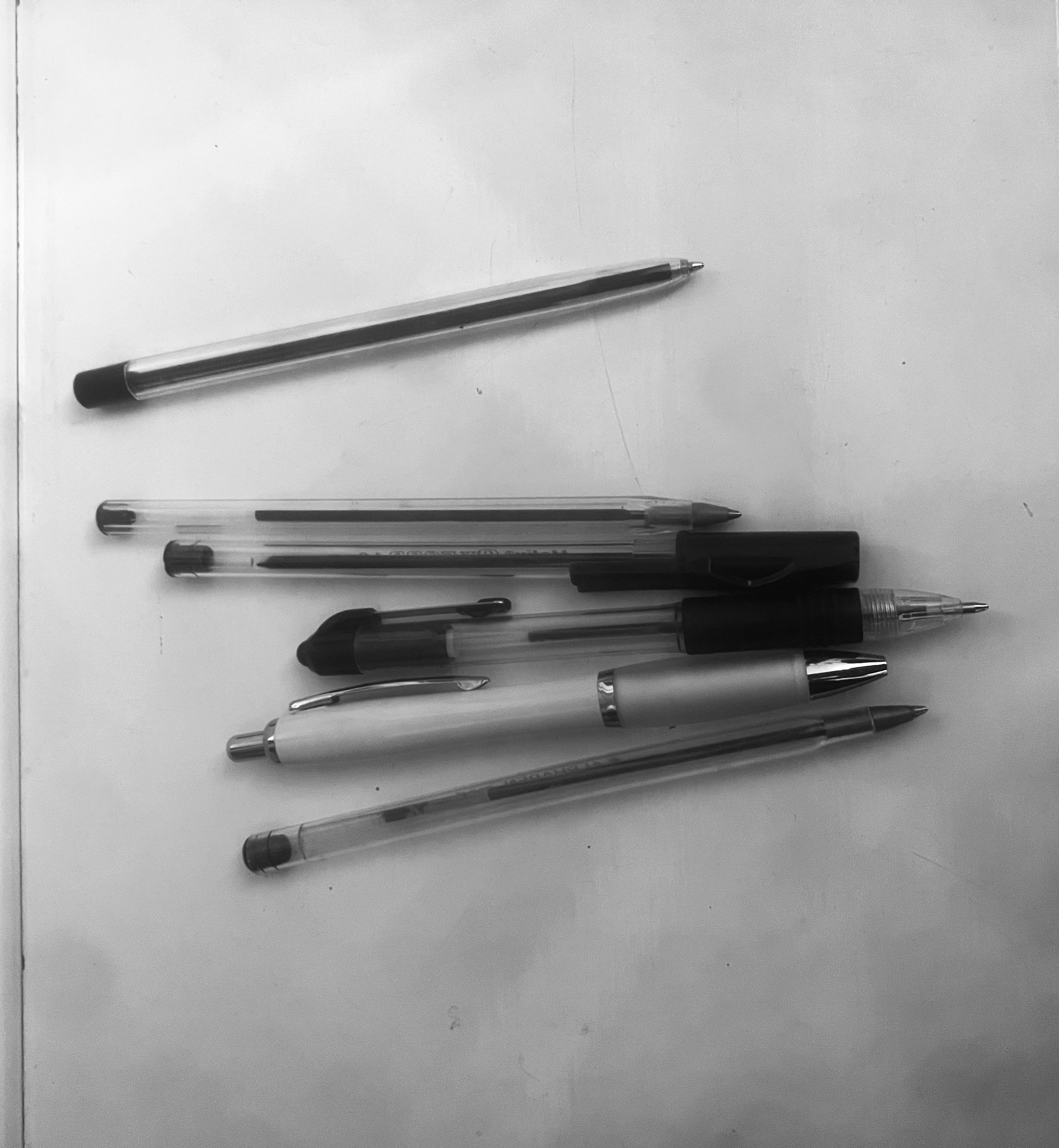
The routine always began after changing into his pyjamas and brushing his teeth, when the house had settled into the late quiet that made every sound seem deliberate. The clock in the kitchen clicked faintly and somewhere downstairs a television murmured through the floorboards, words too soft to understand. He stood at the table, hands resting on the edge, looking down at the drawer.
For a while he had tried going straight to bed the way people advised, pulling the duvet up and switching off the light, waiting for sleep to drift him away. But the thoughts came quicker in the dark and stayed longer, and after two nights of lying awake until morning, he resurrected the routine.
It embarrassed him even to acknowledge it plainly. The whole arrangement was absurd, a careful system of counting and locking and checking, like a private bureaucracy regulating an unspeakable danger. At times it reminded him of something Kafka might have written, a punishment meticulously administered without anyone explaining the crime.
He opened the drawer.
The pens slid forward slightly as he pulled it out, a loose scatter of blue plastic barrels and clear caps knocking softly together. They were ordinary writing pens, cheap and weightless, the kind that accumulated in drawers and coat pockets. Twenty of them. There had to be twenty.
He tipped them onto the table.
They spread across the wood with a faint clicking sound. One drifted toward the edge before stopping against the lip. He placed his finger on the first pen and began.
One.
Two.
Three.
He moved them into a straight line as he counted, aligning them side by side so the blue bodies touched and the clear lids pointed in the same direction. The neatness mattered. Disorder bred doubt.
Four.
Five.
Six.
He dreaded to think how many hours he had wasted this way. An hour most evenings, longer when he had to begin again. Weeks perhaps, even months if the time were gathered properly, all of it spent standing in the kitchen arranging biro pens into careful lines.
There had been a time when he read novels after dinner, long quiet stretches with a book open beside the lamp. Dostoevsky, Conrad, Greene. Now the hours were spent doing this whilst the world slipped quietly toward sleep.
Seven.
Eight.
Nine.
Through the floorboards he could sometimes hear the neighbours moving about in their flat, chairs shifting, a door closing, the low rise and fall of conversation. Ordinary people living beneath him, unaware that their neighbour upstairs had built an elaborate nightly ritual to protect them from something horrific.
Ten.
Eleven.
His sister said that everyone has strange thoughts sometimes. She told him gently, while stirring sugar into her tea that the trick was not to indulge them.
You have to pull yourself together a bit.
Twelve.
Thirteen.
He knew she meant well. The advice assumed the thoughts were small things, passing curiosities that could be brushed aside. But she was not in the conference room two years earlier when that word left his mouth.
Fourteen.
Fifteen.
Even now he could feel the silence that followed, the immediate collapse of conversation around the table. The man across from him had looked up sharply, confusion first and then fury.
Sixteen.
Seventeen.
He had tried afterwards to explain that the word had arrived in his mind uninvited, that it had nothing to do with what he believed, but even as he spoke he could hear how weak it sounded. Words once spoken did not easily accept that kind of defence.
Eighteen.
Nineteen.
Since then the memory repeated itself with terrible clarity. He thought of Raskolnikov wandering the streets after the murder, replaying every movement and sentence in an endless loop of moral accounting, except that in his case the crime had not even been fully committed and yet the guilt had arrived all the same.
Twenty.
He exhaled.
The pens lay in a perfect line across the table.
Twenty.
He counted them again, touching each one with the tip of his finger.
One.
Two.
Three.
The possibility that if such a thought could appear in his mind at all meant that some small part of him believed it.
Fourteen.
Fifteen.
Once the thought had appeared it clung stubbornly to the edges of his mind no matter how firmly he tried to dismiss it, rather like the imagined blood on Macbeth’s hands that no washing could quite remove.
Sixteen.
Seventeen.
Eighteen.
Nineteen.
Twenty.
He gathered the pens into a bundle and stretched an elastic band around them. The lockbox beneath the sink felt cool and solid in his hands. He placed the pens inside, closed the lid, and turned the key until the mechanism clicked.
The safe in the hallway cupboard received the box with a dull final sound. He spun the dial and shut the door.
The keys he counted five times before locking them away.
When everything was finished the kitchen looked exactly as it had before.
Upstairs he lay motionless in bed staring into the darkness while the quiet of the house settled around him. For a while the calm followed, the fragile sense that the night had been contained.
Then his mind began replaying the counting.
The pens scattered across the table.
His finger touching each one.
Nineteen.
Twenty.
He remembered the moment when one had rolled toward the edge and he had reached to stop it.
In the darkness he tried to reconstruct the line exactly as it had been.
Twenty.
But the number would not stay still.
Because he could not quite remember whether he had counted that pen before it rolled or after.
Nineteen.
Or twenty.
Or twenty-one.
He lay motionless, listening to the quiet house, and thought briefly about getting up again, going downstairs, unlocking the safe, beginning the whole careful process once more, which would cost another hour of the night at least.
Instead, he remained where he was.
And slowly the thought settled into place that somewhere in the house, in a drawer or beneath a chair or on the floor beside the table, there might still be one pen.
A single ordinary pen.
And if there was a pen loose, the letter could still be written.
I loved your reference to Kafka, since I'm fond of his work-- and the blend of ordinary and eerie in this piece really did remind me of Kafka's work. You have juxtaposed the calm and the disquietness so well. I also enjoyed the structure of this piece-- with more details being revealed as the counting goes on.
As someone with pure Obsessional this was scarily accurate and a little too close for comfort on a cold Tuesday morning. Excellent work, Wayne!