

false front (part 1) applause
A woman applauded as a hero during lockdown hides a truth too tangled for applause.

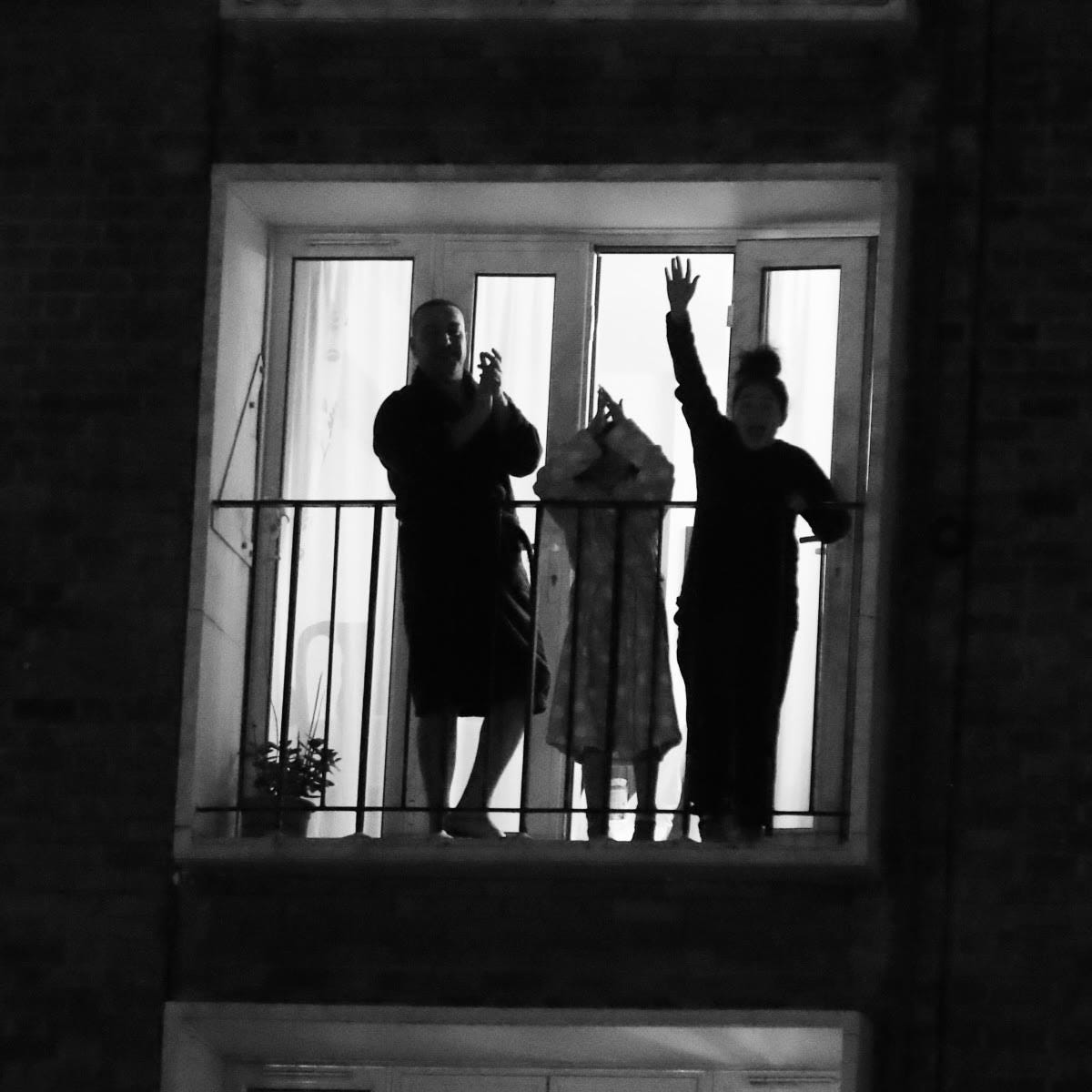
Thursday, 30 April 2020
The clapping started early this time.
A saucepan lid, somewhere across the road, banged twice like a warning shot. Elaine flinched, still sitting in the driver’s seat, gloved hands resting on her lap. Another lid joined in. Then hands, then whoops, then the unmistakable sound of someone blowing into a party horn, as if the war had just ended.
Geoff would be at the window, of course. Same as every Thursday. Standing with his mug of tea, his face lit by the amber lamp behind him, waving like a proud father at a school play. She could already hear what he’d say when she came home: “You’ve got your fan club out again.”
She stayed in the car, barely moving. Staring forward. Engine off. Seatbelt still on. The wipers were mid-arc, frozen when she’d turned the key. Rain tapped at the roof, soft as fingertips.
Outside, neighbours leaned from doorways and balconies, some still in slippers, some banging pots with wooden spoons like children. The sky had that peculiar washed-out grey that always made the houses look older.
A child’s voice—Thomas, from number 12—shouted, “That’s her! That’s Elaine!” and started clapping harder. Others turned. Smiling. One even saluted. Elaine lifted her hand in a small wave through the windscreen. She didn’t smile.
The lie had started years ago. A one-off excuse to leave the house one Thursday night. “I’ve signed up for St John’s,” she’d said, not quite meeting Geoff’s eyes. She never expected it to stick. But Geoff nodded, proud before there was anything to be proud of.
“That’s my girl,” he’d said. “You’ve always had such a good heart.”
The lie had become routine. She left just after seven, three times a week. Driving the ambulance on the “night shift”, returning in the morning while Geoff brewed the tea and ran the hot tap to defrost her mug. Over time, the betrayal had calcified. It had shape now. A lanyard tucked in her bag, a uniform folded neatly, a schedule. A life.
Before, she had carried her own silent guilt. But Covid made it louder. The volume became unbearable when her community started to clap her.
She leaned her head back against the seat and closed her eyes. The sound of cheering drifted in through the rain, absurd and joyful.
The uniform she wore wasn’t even real—a borrowed jacket, an old ID badge from a one-off training session. Enough to satisfy questions. Enough to look the part.
The worst of it wasn’t the clapping. It was how grateful everyone looked. How sincere. How proud Geoff sounded when he said, “She’s out there doing her bit. Not like me.”
She wanted to scream. To claw the sound out of her throat and into the night. But the applause pinned her in place.
Instead, she opened her eyes and watched the street.
Someone waved. She nodded again. Her hands stayed in her lap.
The world thought she was sleeping in car parks and ambulance bays. They imagined her out there, in the empty dark, one of those brave few—like knights on quiet roads—riding into the risk while everyone else stayed inside with their windows shut and the news on.
She knew what that looked like. She remembered driving through town early on, in the thick of the first wave—how the streets were hollowed out, shopfronts dark, traffic lights changing for no one. Back then, just being on the road felt like an act of courage. People assumed she was part of that. Applauded her for it.
But the truth was parked somewhere else, in a quiet cul-de-sac across town. A house with a green door and a man who made her toast before bed. They didn’t always talk. Sometimes she just listened to the clock.
Her phone buzzed. A message flashed on the screen:
Everything alright? Want me to put the kettle on?
She didn’t reply.
A tear slipped down her cheek, quick and quiet. She wiped it away before it reached her chin.
She waited until the clapping faded. Until the sound died into the soft hiss of rain. Then she started the car again and drove.
Not to the depot. Not to the station.
But to where she always went.
To where no one clapped.
The starting imagery of people clapping for Elaine is such an impactful way to start. I really liked how you contrasted the sounds and activity of people clapping for her with the almost quiet remorse that Elaine feels when she is driving alone. Curious to know where she went in the upcoming parts.
Wayne, this is another beautifully written story that gently teases and tantalises us to want to know more. It’s a story full of emotions that the reader can identify with - set during the pandemic, the pride of the husband and community in the (believed) selflessness of Elaine, neighbours clapping and banging saucepan lids as we all did, in appreciation of their efforts, and the emotions those actions promoted in us. The guilt of Elaine personified in the imagery of a tear streaming down her face and hurriedly wiped away. I think it’s important that we have literature and other works of art that capture the essence of those fearful and lonely times because, for sure, I’m already forgetting those small details, such as traffic lights continuing as normal when there was no traffic to control. Very much looking forward to part 2!